Is Our Unschooling Life Rich Enough?
Some unschooling families seem to live very adventurous lives that make ours look rather ordinary. And I wonder: Is our life rich enough for our children? Are they getting all the opportunities they need to learn so that they grow into the kind of people who will change the world for the better?
Perhaps it’s time for us to live differently. We could buy a farm, grow our own organic vegetables, have alpacas, spin wool, weave our own cloth, live in a yurt, go off-grid. Yes, we should get back to nature, step completely outside mainstream society, give our kids experiences not many people get to have. It would be good for them and good for the environment too.
But if we don’t move to a farm, we could buy a campervan and then travel around Australia. See our country firsthand. Or we could sell our house, buy plane tickets, travel the world, and experience cultures different from ours.
I’ve read about these kinds of unschooling lives. They seem exciting, and rich with experiences and much more interesting than our family’s seemingly conventional existence.
We seem to be drawn to what is different, what is novel. We dream. What would our life be like if we gave up the normal things that we’re doing and set out on bigger adventures?
Years ago, I yearned to live a back-to-nature life. I dreamed about getting away from town and having a few acres where we could grow our own vegetables. I wanted to raise some chickens and have fresh eggs, do lots of baking, maybe have a cow or two and a goat and perhaps a donkey. If we had space, our kids could go wild and make lots of noise because we wouldn’t have any close neighbours. We could do whatever we wanted on our own patch of land.
This idea remained a dream until one day, a friend told us about a cottage that was on a 100-acre fish farm. The friend knew the owner of the farm and told us he was looking for someone to live in the cottage and feed the fish. All we’d have to do was throw some feed into the dams every evening. In return, we could live in the cottage for free. No rent whatsoever. This seemed like the answer to my dream.
I asked if we could visit the cottage before making a decision so one afternoon, my husband Andy, our children – we had five at the time – and I all piled into the car and drove quite a long way south until we arrived at the fish farm on 100 acres of Australian bush. The bush looked different to the bush that surrounds our house. With its tall gum trees and native flowers and sandy tracks, ours is very beautiful. But this bush didn’t look so attractive. The trees were stunted and the bushes were low growing. But it was wild and untamed. It was nature. And this bush was home to a large mob of kangaroos. Who has kangaroos living on their property? It all seemed very romantic.
We had a look at the cottage and my heart fell when I saw it. It was very rundown. No one had spent any time or money on it for years. The cottage had probably been used as a weekender for many years. Maybe the owner had stayed there when he came to feed his fish. But it hadn’t been a proper home for a very long time. And it was very small. Andy, being the sensible man he is, shook his head and said, “No, Sue, we couldn’t live in this cottage. We have five children. It’s only got two bedrooms. Look at the state of the place. There are holes in the walls, cracked windows and dirt. It would never make a nice place to live and to bring up children.”
But the state of the cottage wasn’t the biggest problem: “It’ll take me two hours to get to work and two hours to get home again.” Four hours of travelling very single work day.
I didn’t let Andy’s objections stop me from thinking about the possibilities. I imagined all we could have: organic vegetables, the donkey, the chickens, the goat and the alpaca. I told Andy how much the kids would enjoy the 100 acres. They’d have lots of space to play and ride their bikes. They could dig in the soil and get as dirty as they liked because no one would see them. They could wear old clothes every day.
“We could repair the house,” I said. “We could fill in the cracks and holes, paint the walls, and replace the broken windows. Anyway, who needs a beautiful cottage? Wouldn’t it be more adventurous to live in a rundown cottage on 100 acres of land?” We didn’t need a pristine house like the ones in town.
And then I suggested, if we moved, we could get a dog. My kids had never had the opportunity of having one before. We had always lived in rental homes and dogs were never allowed. When my children heard the word ‘dog’, they added their voices to mine: “We want to live in the cottage, Dad. Wouldn’t it be fun to live on a fish farm?” Andy said he would think about it.
When we got home, I went to the library and borrowed every book I could find about ducks, chickens, donkeys, bottling fruit and vegetables, and everything else to do with a hobby farm. And I kept bringing up the subject of the cottage. And Andy kept saying, “It’s a long way from work,” and I kept replying, “Perhaps you can get another job closer to the cottage. You’re not happy with your present job. This could be a good opportunity for you to get a new one, for us to move and live our adventure.”
And then one day, Andy said yes. We could give life on the farm a go. (I reckon he must love me very much.)
So we packed up and moved: Andy, our five children and I. Our eldest child was eleven at the time, and our youngest was one.
The first thing we wanted to do was get the promised dog. So I answered an ad in the newspaper and drove back to town where I found a Collie/Kelpie cross called Rocket. She was a working dog but was living in town. She had too much energy and she was always escaping from her owner’s house. She had been picked up on the street and taken to the animal shelter one time too many, and her owner had decided that town was the wrong place for her to live. We ignored the fact that Rocket was an escapee. We thought she’d be fine living on our large property. Where could she escape to? She’d have a wonderful time on the farm. She’d be a perfect pet for our children. So I said we’d give the dog a home. Rocket’s owner looked rather relieved.
And then a short while later, I realised that Rocket could easily escape from the farm because all the fences surrounding it were in very poor condition. When our neighbour saw our dog, she came up to the fence bordering our two properties and called us over. Her first words were, “If that dog jumps over my fence I’ll shoot it.” I started to worry about the dog. What if she got out onto the road? What if she jumped over the fence? Having a dog wasn’t as good as I had imagined.
The land wasn’t as good as I’d imagined either. It was home to a lot of venomous snakes. I didn’t think it was safe for our kids to roam free. I wanted them to stay close to the house. And although we had lots of space and we could have grown vegetables, it didn’t take us long to realise that the soil was of very poor quality. That’s why the trees were stunted and the vegetation was low growing. And the other reason they were like that was because it hardly ever rained.
We had a water problem. There wasn’t enough to grow vegetables. We hardly had enough for our personal needs. The water tank become the focus of my life. I spent a lot of time at the top of the ladder that was positioned next to the tank checking the water level. Did we have enough to survive another week?
Regularly, we would hear a strange gurgling noise in the pipes indicating that we were almost out of water. I’d phone the carrier and hope that he could deliver some water to us that same day. The water truck would arrive and we’d go outside and watch it back up to the tank. The driver would attack a big hose to the truck and then insert the other end into our tank before pumping the water. Always, he lost some water as he was connecting the hose. It was a distressing feeling watching that precious fresh water disappear into the earth. But once the tank was full, we felt good. Perhaps we could have a shower or do some washing. But after a few hours, we’d start to conserve water again. How long could we make this tank last?
There was another aspect of country life that we didn’t enjoy: Sharing our home with thousands of rats and mice. During the night, we could hear them running and scratching in the cavity between the walls. I imagined them appearing through the holes, running over the floor and then up onto our bed. In the morning, all our mousetraps were full. But we never seemed to get the rodents under control. We adopted two cats to help with this problem, but they couldn’t keep up with them either.
Andy was getting tired because of the long drive to and from work. I was also getting tired. Music lessons and other activities were a long, long way from home. It took us all day to drive to town for these lessons, and do our shopping and come home again.
Before moving to the cottage, I had said to Andy, “Just imagine being here in the summer! The kids can swim in the dams. It will be wonderful.” But it wasn’t. No one wanted to get into the unlined dams which were cloudy with sediment and contained all kinds of unidentified plants and creatures as well as the fish. We just weren’t adventurous enough.
Although things were very different from what we had expected, we didn’t at first give up. We faced each challenge as it came along. We tried hard. We had a good attitude. Yes, the experience wasn’t turning out as we’d hoped, but we were learning a lot and maybe things would get better. It might rain. Perhaps Andy would get a new job. That would make all the difference. We reminded ourselves that dreams take time. We couldn’t just run back to town. We had to give things a fair go.
But one day, the owner of the farm announced that he wanted to sell it. He no longer wanted us to feed his fish. This meant we had to move. We talked about this as a family. Did we want to find another farm to live on? Or should we head back to town?
By this time, I was pregnant with our sixth child. Before we had made a decision about a new home, I had to have an ultrasound. So one afternoon, I drove from the farm and met Andy at the hospital in town. He took our children to the park while I went to see our baby for the very first time. I entered the ultrasound room feeling excited. I left in tears. Our unborn baby had ‘an abnormality incompatible with life’: He had a hole in his diaphragm. I was told that some of his organs had moved through that hole and were taking up space in the lung cavity. There was not much room for his developing lungs. The doctors predicted that by the time our baby was born, he wouldn’t have enough lung tissue to survive after birth. In other words, he was going to die.
Suddenly, our dream of living on a farm didn’t seem important. I no longer cared about growing my own vegetables, raising animals, and spinning wool. We decided that we should move back to town. We wanted to be close to the hospital. We wanted to live in a house with town water. We wanted to be close to all the facilities. We had enough to think about without having to worry about all the little details of life. We were happy to go to the shops and buy our food, and turn a tap and see an unending stream of water appear. Yes, being self-sufficient didn’t seem to matter any more.
So we found a suitable house, a conventional house, back in town. It had a good garden and beautiful surroundings, but it certainly wasn’t an adventurous farm. It was just an ordinary-sized house on an ordinary-sized block of land.
Some months later, our son was born. We called him Thomas. He lived for a day and then he died. And soon we realised that we were having experiences that nobody would ever ask for. We were learning things we didn’t want to know about. We learnt about the things that matter: what life and love are all about.
And we discovered that it’s not important whether we live in a yurt or a campervan or a tumbledown cottage on a fish farm or an ordinary house in town. As long as we love. It’s love that enriches our lives. It’s what our kids need to experience. It’s love that will change the world.
I ask my girls, “Would you like to live in a yurt?”
“A yurt? Why would we want to live in a yurt, Mum?”
“Do you want to travel the world?”
“No, we like living here at home.”
Yurts and farms and campervans are perfect for some people, but not for us.
We no longer live in town, but we still live in a conventional house situated on an average-sized block. This is our home. This is where we unschool. This is where we experience unconditional love.
Photos
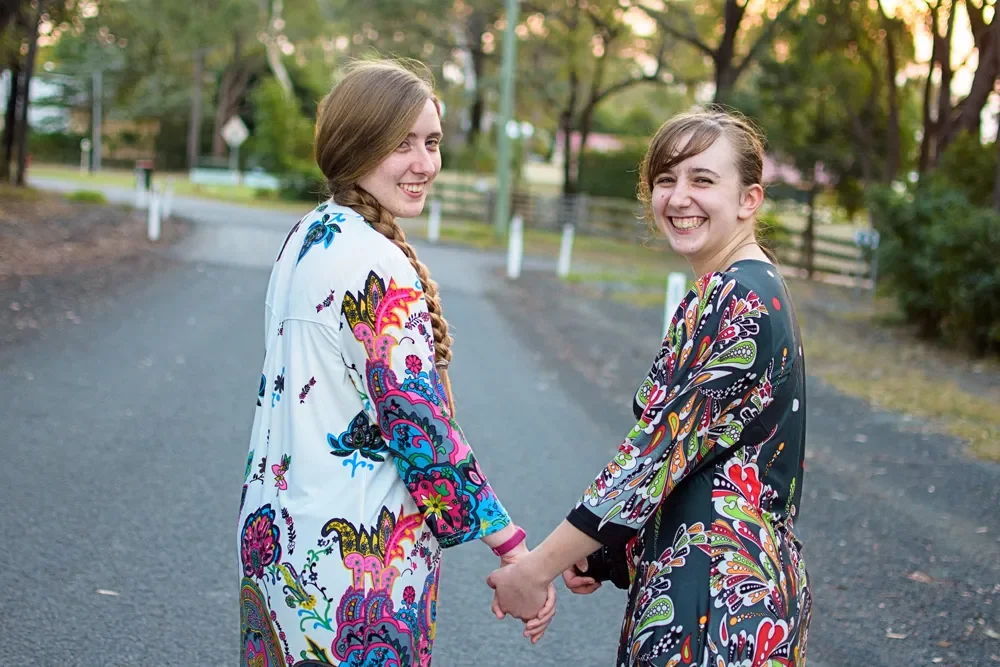
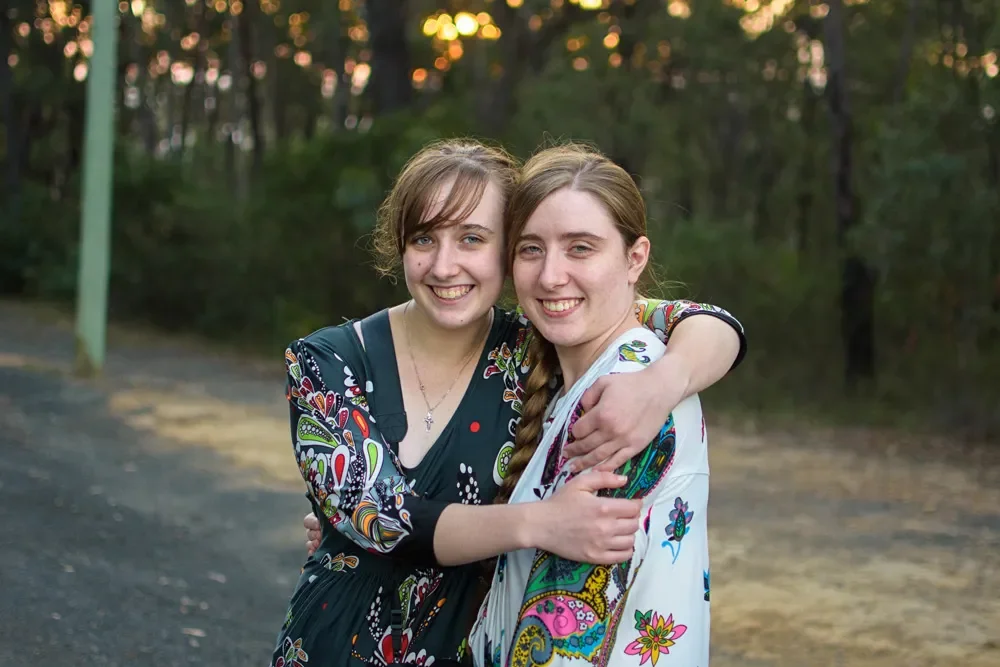
My daughters Sophie and Imogen are walking home. As you can see, we live on an ordinary street. But what’s not ordinary is the beautiful Australian bush that’s close to our house. The smiles on my girls’ faces aren’t ordinary either. Nor is our unschooling life.
I told this story in episode 84 of my podcast: Are We Living a Second Best Kind of Unschooling Life.
So what kind of unschooling life do you live? I’d love to hear about your home!