Perfectly Them
Do you remember the first time you saw your child? That was a magic moment, wasn’t it? I bet we all thought our newborn babies were absolutely perfect.
It’s very sad that initial impressions wear off. We begin to see faults in our children. As they grow, we criticise and complain. Perhaps that’s because we wonder how they’re going to get on in life and fit into the world. If only they were different.
Maybe we justify our negative words. Surely it’s our duty to point out our children’s faults? They need to know what they have to work on, don’t they?
Or maybe they don’t.
I had an interesting discussion with my daughter Sophie after we’d been to a homeschool gathering. Sophie listened as a mother told everyone in earshot how lazy her daughter was. Her daughter was in earshot too.
Sophie was horrified that parents, not only criticise their kids but that they do it in public. How would adults feel if we overheard someone finding fault with us? What if they criticised us to our face?
Sophie observed two friends enjoying lunch together in a café where she worked. The women were halfway through eating their egg and bacon rolls when another woman approached their table and said, “You shouldn’t eat that food. You’re fat.” She then pointed out that she had no problems with her weight – she was slim – because she was careful about what she ate. She thought that the two women should follow her example.
Everyone in the cafe could hear the unkind words directed at the friends. How must the women have felt? Sophie could see that their lunch together was spoiled. She cleared away their unfinished meals.
This incident makes me feel very sad. It’s just not acceptable for an adult to criticise another adult, especially in such a direct and unkind and public way, is it?
But what about children? We often hear parents pointing out their ‘faults’: “You’re too shy… lazy… clumsy… thoughtless… noisy… stubborn… unkind… selfish. You should watch what you eat and exercise more. When will you ever learn to do…?” They talk about their kids to other people. Their kids hear.
How do criticised children feel? Do they feel hurt? They know that they aren’t loved and accepted just as they are. Could they be ashamed of who they are? Perhaps they feel like they are no good.
Maybe that’s the whole point of criticism. If we make others feel bad, perhaps they’ll do something about their ‘faults’. But will they?
“Putting kids down makes them feel terrible,” said Sophie. “It doesn’t spur them on to do better. They just give up trying.”
So what do kids need? They need to be accepted just as they are. But what if they really do have faults? Surely we can’t accept our children’s flaws? We can if we love. All the things we worry about might melt away under the influence of unconditional love.
“Sometimes parents complain about things that aren’t faults at all,” said Sophie. “These could be the things that make their children unique and special.” It’s a pity that we don’t see that.
Years ago, I knew someone whose daughter was awkward and ungainly and not, on first impressions, as attractive and gifted as the other children. Maybe many of us might have been embarrassed if she were our daughter. Perhaps we’d wonder what other people were thinking of our child. Would we want to change her?
One day, the girl walked by with a crowd of other kids. Seeing me watching her, a friend whispered in my ear, “Her mother treats her like a princess. She feels as beautiful as the other girls.”
And she was beautiful. We just weren’t looking with the right eyes.
Maybe that’s our problem. Our vision has become blurred. We’ve let other things get in the way of seeing our children clearly.
Our children don’t have to fulfil other people’s expectations. They don’t have to be the people others think they should be. There is no reason why they should change to match our own ideas. Our children are perfectly them just the way they are. Just like they were the day they were born.
This story can be found in my book Radical Unschool Love along with lots of other love stories. If you haven’t yet read my second unschooling book, why not check it out?
Something Extra
If we’ve lost it that magical feeling we experienced when we first met our children, how can we regain it? How do we once again look at our kids with awe and gratitude? How do we make them feel accepted exactly as they are?
I have a very simple idea, and it won’t take long to put into action. It’s not all the answer, but maybe it’s a beginning. We could tell each of our kids about the first time we met them, and how we felt. (This would work well for adopted children too.) And then we could tell them how we love them so very much. Even if we have no trouble accepting our kids just as they are, it never hurts to share what’s in our hearts, does it?
The other day, I told my daughter Gemma-Rose about her birth day and how I‘d felt. I said my heart overflowed with love. I didn’t think I could ever love more than I did at that moment. But my love keeps growing and growing. How thankful I am to have Gemma-Rose in my life. We talked also about how proud of her I am. I was specific. It was good to look and think carefully about who my daughter is. She is a beautiful person! It was such a joyful conversation.
So, what do you think? Have you told your kids how unique and special they are? Have you shared how you felt on the day you first met them? Maybe if you haven’t done that for a while, now could be a good time to spread some joy!
Image
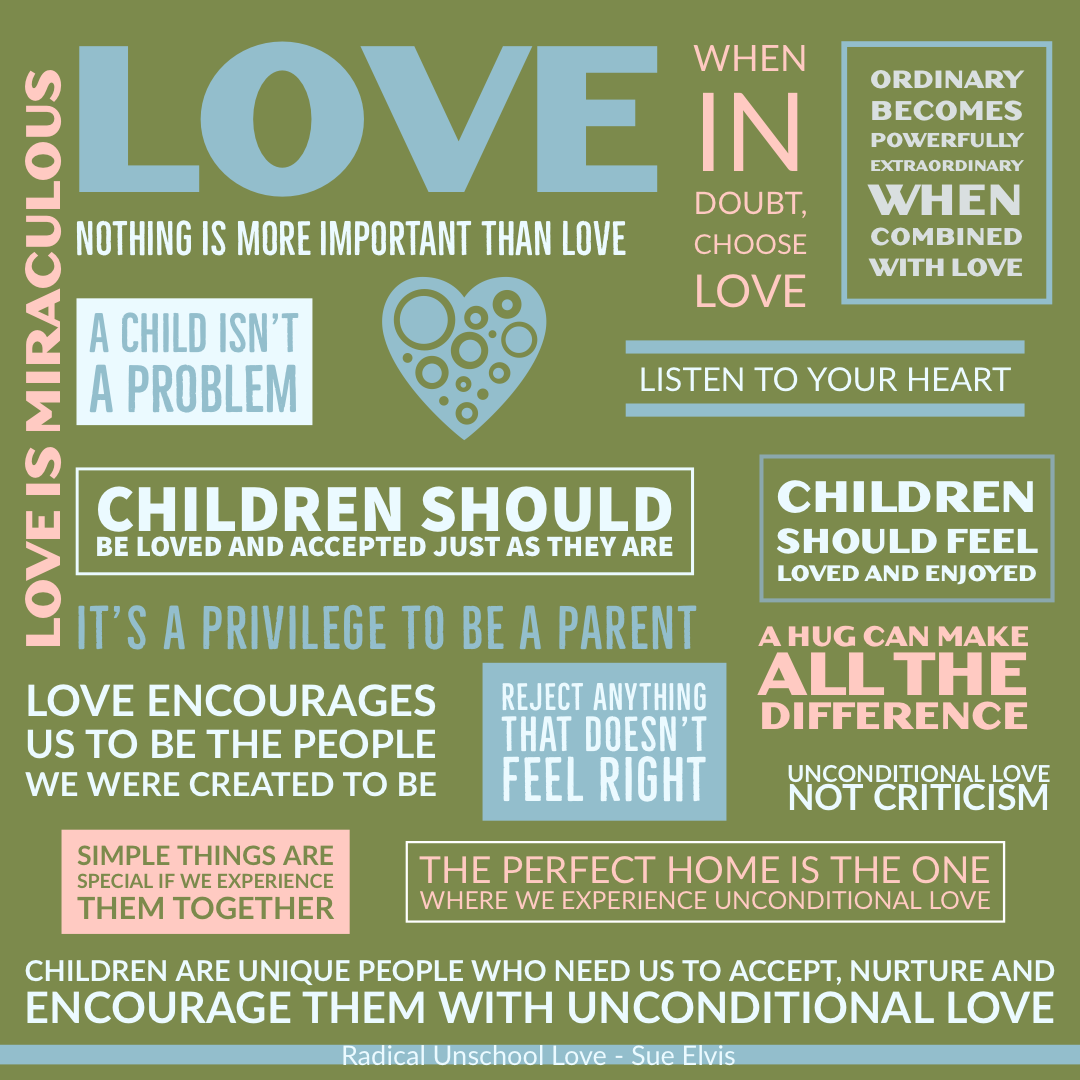
I took some of the love story ideas from Radical Unschool Love and turned them into a graphic!