REAL LIFE Junk Mail Catalogue MATHS
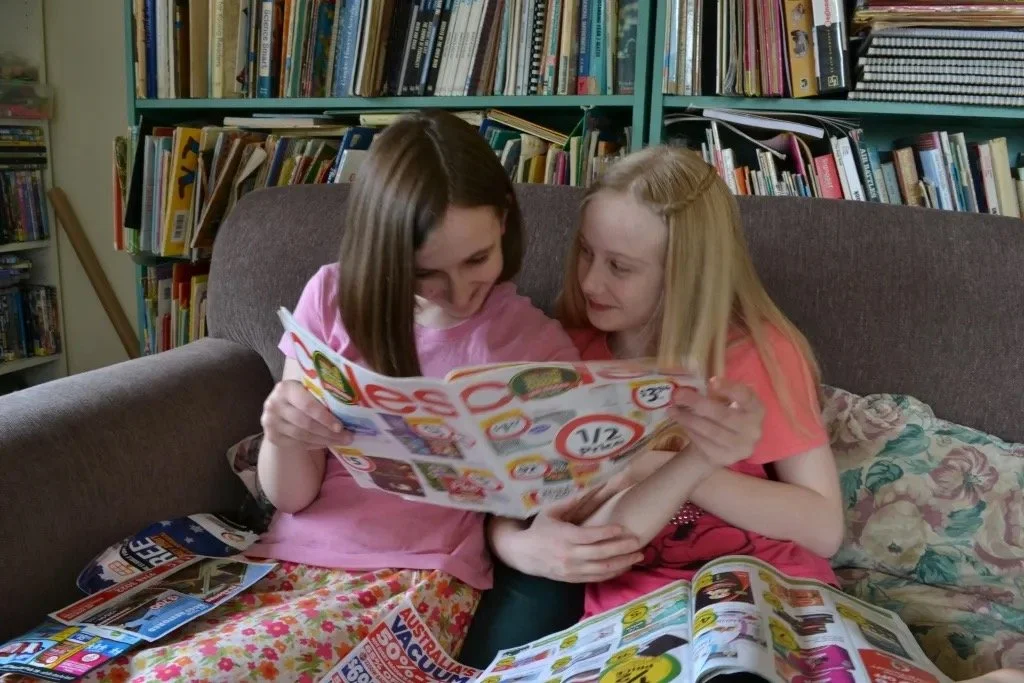
Yesterday, I noticed a pile of junk mail catalogues sitting on the kitchen bench, waiting to be thrown into the recycling bin. I had an idea…
“If I gave you $500 what would you buy, if you could choose anything from these catalogues?” I asked my youngest daughters.
Both Gemma-Rose’s and Sophie’s eyes lit up as they began thinking of all the wonderful things they could buy.
“Is the $500 real or imaginary?” asked Sophie hopefully.
“Imaginary, of course!”
I rather expected the girls to lose interest at this point. Would they think my question was a boring maths exercise in disguise? I was quite prepared to abandon my idea. In fact I didn’t say much more about it, but went off to my bedroom to get ready to go out.
When I reappeared, I noticed Gemma-Rose completing her morning chores with one eye on a catalogue. “Well, I wouldn’t buy any of these baby clothes!”
Sophie was already shopping in her imagination too. “I could buy some of this jewellery but it’s rather expensive.”
As I was going out the door, I said in an off-hand way (no pressure, only if you want), “You could make lists of everything you decide to buy. I’d love to look at them when I get home.”
Two hours later, I was greeted with, “You should see what we bought. Gemma-Rose managed to buy 9 items with her money. I bought 8.” Both girls had a list of numbers (prices) neatly added up.
Today, I again had to go out. Would the younger girls like to do some more imaginary shopping while I was gone?
“Perhaps you could choose a gift for every member of the family and then let me know how much money you’ll need to buy them all.”
When I returned home this morning, I asked, “What did you buy everyone?”
“I bought Callum a shed!” laughed Sophie.
A shed? “Perfect! He’ll be able to store away all his spare car parts. That’ll tidy up the garden. Great choice!”
“I bought you a heart-shaped necklace, and Gemma-Rose bought you a lamp. It’s one of those with a magnifier.”
“That’ll help with my poor near-sight,” I smiled. “I can use it when I’m embroidering.”
“I bought Imogen a sewing machine. She’s been saying how much she’d like one.”
The girls told me about the rest of their gifts with great excitement. They’d obviously enjoyed choosing them.
“How much did you spend altogether?”
“I spent $1 607.98. Gemma-Rose spent even more.”
“I spent $2 188.47.”
“What a lot of money!”
“Yes, but we combined our jewellery purchases. Together we bought 5 items so we were entitled to a free bracelet.”
“And one item was $50 off, a real bargain!”
“Pity, we were only shopping in our imaginations.” The girls sighed. Then they said, “But it was fun dreaming.”
I think about my heart shaped necklace and my magnifier lamp. I suppose I will survive without them. Sophie and Gemma-Rose are right. They didn’t need to spend real money. It was good fun pretending.
“What shall we buy tomorrow?” the girls ask.
I’m thinking we ought to buy some groceries. The pantry is looking a little bare. “You could shop using the Coles supermarket catalogue.”
And I thought junk mail catalogues were useless rubbish. They’re not.
They are real life maths.
Update
I said, “Would they think my question was a boring maths exercise in disguise?”
I’ve been thinking a lot about those words. Do we try to ‘trick’ our children into learning what we feel they need to know? I’m in the middle of writing a blog post about this. if you’d like to share some thoughts, please watch out for it!
Here’s the post: The Problem with Disguising Maths Practice as Fun.