Rules, Responsible Parenting and Radical Unschooling
If you do a Google search on unschooling it won’t take you very long to find someone criticising unschoolers. The most judged unschoolers are those who have adopted a radical way of life: those who do not force a set of rules and regulations upon their children, in the area of parenting, as well as education. The critics are quick to point out that without parental control and rules, children will go off and do whatever they want without regard to anyone else. They will run wild and be inconsiderate, lazy and selfish. They won’t learn right from wrong.
What about my own unschooling children? Are they wild and undisciplined? Maybe not, but you’re not radical unschoolers, you might say. You limit your unschooling to educational matters, and are sure to impose limits and rules upon your children to ensure they are well brought up. You are parenting responsibly. At one point in time, I might have agreed.
When my first daughter was young we had lots of rules and regulations. I wanted to train my children well. I considered it my duty. It wasn’t long before I discovered something very interesting about rules: they result in children and parents fighting for power. It was such hard work staying in control. The end result wasn’t a well-disciplined child who accepted my rules because she saw they were in her best interests. Instead she longed to rebel but couldn’t because I was the parent and she was the child, and if she did decide to ignore my rules, she knew she’d be punished.
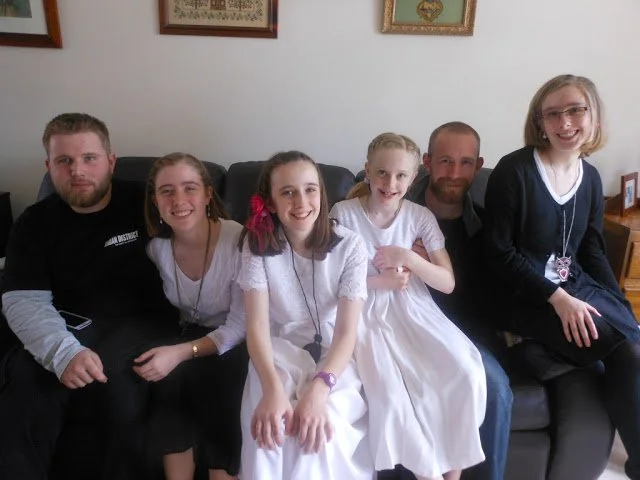
But somewhere along the way, our parenting changed. Like our homeschooling, we knew things weren’t right and gradually, and naturally, rules and power struggles fell by the wayside. The end result? Wild selfish children? No, we have hard working, well-balanced, considerate children who know right from wrong, and who love their Faith.
And I wonder how this happened.
We have no rules about such things as TV, computer use, bedtimes, dress codes and attending Mass. We do have a roster for chores but somewhere along the way, it was taken over by my children, and it no longer has anything to do with me.
Despite not having clearly set out rules, our children don’t watch TV. They enjoy a DVD here and there. They each have a computer which they use every day, but they don’t spend excessive time in front of the screen. They play computer games whenever they feel like it which isn’t that often. They dress appropriately and I’ve never had even one battle about what they want to wear.* They all choose to go to bed at a reasonable time they have decided is appropriate for their needs. Without fail and without complaining, they contribute to the upkeep of our home. They always come to Mass with us, and turn up for morning prayers. Even the issue of appropriate books and movies doesn’t seem to be a problem.
I ask my children a few questions:
“Would you ever consider not doing your jobs?”
“No. The house would soon become a mess. I wouldn’t want to live like that.”
“You might think it’s my job to do all the work as I’m the mother.”
“The mess belongs to all of us.”
“But no one’s forcing you to work.”
“It wouldn’t feel right not to work. We all have to do things we don’t particularly enjoy doing.”
“You are choosing to do your chores?”
“Yes.”
I think that choosing to do what is right is much better than being forced into doing it. Motivation comes from within and so will remain even when parents aren’t physically present with the threat of punishment.
So it seems to me that children can learn to be considerate, and know right from wrong without imposing rules and punishments. Could it have to do with modelling the values, beliefs and practices we want to pass onto our children? Could it involve showing respect to all, about regarding everyone as valued members of the family team, about listening, about acknowledging everyone’s needs and responding to them with love and not punishment? Might it be about building up children’s inner sense of ‘right’ feeling? Is it about parenting gently; is it about attachment parenting? I don’t really know. These are just random thoughts.
But back to radical unschooling…
I used to hear the word ‘radical’ and recoil. Radical unschoolers seem to lead lives so different to ours. I listened to such words as ‘neglectful’, ‘lazy’, ‘allowed to do whatever they want’ and ‘wild’ and I didn’t want to know. These days I am trying to look past the obvious life-style differences, in an attempt to understand. I am pondering new ideas.
From what I have been reading, I see that contrary to popular belief, radical unschoolers do not practise hands-off parenting at all. I have actually come across the words ‘attachment parenting’ in association with ‘unschooling’ quite a few times. Could it be that radical unschoolers have well-adjusted and well-parented children after all? Could the critics be wrong?
I still have lots to think about and work out…
Could radical unschooling be an extension of attachment parenting? Can Catholics radically unschool? And could unschooling already have affected more than just the educational part of my family’s lives? Could we have moved towards ‘radical’ unschooling?
That is quite a radical thought.
*(Okay, I admit I once had a grumble or two about my son Callum not ironing his Mass shirt, which was rather silly because the fact he always chooses to come with us to Mass is much more important than what he was wearing.)