Accidental Unschoolers
This is the second part of our homeschooling story. It follows on from my post Undercover Homeschoolers.
When our first child Felicity was about 6 years old and we’d been homeschooling for maybe a year, I met Anna. She lived in a wooden oasis of a house on the top of a hill that led down to the creek and the bush. The house was a warren of fascinating rooms filled with unusual treasures, a real storybook home.
And in that storybook home lived a storybook family. We were sure of this. Anna had a beautiful family: polite and charming children who excelled at everything. They were musicians and dancers and craftsmen and academics. And they were perfect.
An invitation to Anna’s house was like an invitation to the palace. We would set out from home full of excitement, knowing we were going to have a fantastic day. Anna would serve Earl Grey tea in fine bone china cups and offer us slices of homemade cake. And we’d sit in her country farm-style kitchen wiping our lips delicately with real napkins while feeling very special.
Afterwards, we’d descend the stairs to the living room, and someone would lift the baby grand piano lid and we’d be treated to a concert where little child fingers would play adult-sized music. While listening, I’d admire the trophies, the exquisite project books full of knowledge, and the displayed artworks and crafts.
Then after the music, we’d hear the magic words: “Let’s put on a play!” My children would follow eagerly along in the wake of their more inventive and creative friends, raiding the dress-up box in search of the perfect costumes.
Later, Anna and I would sit on the deck which jutted out among the bird-filled trees while the children played in the home-made wooden cubby house, perched above the steeply descending path that led down to a creekside paradise. And Anna shared and I listened, eager to pick up tips on how to have such a splendid family. Yes, I wanted to be just like Anna. I wanted to have children exactly like hers.
I enrolled my children in music lessons, then dancing and drama and gymnastics, and filled the house with musical instruments and craft materials, classical music and books. I wanted the same rich creative environment as my friend. I looked out for opportunities to enter competitions that might lead to a few trophies. And I carefully planned units of study and I hoped my children would produce impressive, creative project books to show how much they were learning, books that would rival those of Anna’s family. And although John Holt may have approved of some of the things we were doing, it was Anna I listened to, not John. We’d left unschooling behind.
When Felicity was 9 years old we moved house. We said a very sad goodbye to Anna and her family. But around the corner, there were more friends waiting to share ideas and influence our way of homeschooling.
After we had settled into our new home, I looked around, hoping to find other homeschoolers. And I did find some. There were maybe a dozen homeschooling families in our area. There was even one in our parish. This seemed rather remarkable. In the three or four years we’d been teaching our children, we’d never met another Catholic family who was educating their children at home. But we now discovered there was a whole network of Catholics out there, quietly educating, not only their children’s minds but also their souls.
Our faith hadn’t really played a big part in our homeschooling up to that point. I hadn’t thought much about what God wanted me to do and how I was going to help my children become the people He intended them to be. But after meeting my Catholic homeschooling friend, I started thinking about such things. I read books written by Kimberley Hahn and Mary Kay Clark, and before long, my head was spinning with new thoughts. I now wanted to give my children a good education infused with a solid knowledge and love of the Catholic faith.
I continued reading and thinking and discussing. One day, my friend lent me a copy of Elizabeth Foss’ book Real Learning, and I learnt about living books, narration, the value of outdoor play, nature study, dictation and copy work. I loved Charlotte Mason’s concept of ideas and beauty and providing the right atmosphere and instilling disciplining through good habits. Yes, I liked Charlotte Mason’s philosophy of education very much. But that didn’t prevent me from considering more ideas.
Next, I discovered Laura Berquist. Her book Designing Your Own Classical Curriculumconvinced me that I wanted children who could think and analyse and reason critically. I thought about memorisation, the different stages and the tools of learning. And then I started designing.
Those were exciting times as I read and pondered and experimented. My homeschooling methods swung this way and that and then back again. My poor children!
But one day the excitement disappeared. I got tired of going round and round in circles trying to find the perfect method of homeschooling. Because, even though there were many wonderful ideas contained in all the books I was reading, none of these homeschooling methods seemed to suit my children. Once the excitement of a new method wore off, they’d once again start saying such things as “Why do we have to learn this? Do we really have to do that?” Getting my kids to do their schoolwork was a battle. Our homeschool wasn’t exactly a copy of my friend Anna’s. In our home, learning had turned into a chore.
Eventually, I stopped experimenting with the different methods of homeschooling. Instead of listening to the ideas of such people as Charlotte Mason and Laura Berquist, I began to listen to my children. What were their needs? What were they interested in? What was important to them? What was getting in the way of us being a close and happy family? Other people’s expectations? I threw out all the things that weren’t working for us, one at a time, and gradually we slipped into a way of life that felt comfortable to us. And whenever anyone asked us what homeschooling method we were using, I’d say, “We’re doing our own thing.”
Our days were enjoyable and fun. My children were learning and growing. We’d get up each morning and follow our noses, experiencing real life, having learning adventures, not always knowing what we’d do, where we’d end up or what we would discover. No big plans. Just life. And I felt at peace. Well, most of the time.
Just occasionally, I’d feel a little bit guilty. Was life too easy? Why didn’t I have any battles trying to get my children to learn? Perhaps I wasn’t pushing them hard enough. I wondered: Was ‘doing our own thing’ another word for ‘lazy’? Were my children really becoming the people God wanted them to be? When they finished homeschooling would they get jobs? Would they be ready to make their own way in life? Maybe I was jeopardising their futures. Perhaps we needed to be more structured, plan our days better, and make a few concrete goals.
So at the end of every year, when the long summer holidays rolled around and I had a bit of time to read and think, I’d say to myself, “I really must do some more research, buy a few new books and plan the school work better.” But every holiday passed without me ever doing that. When school resumed, we’d just slip back into our usual routine. We continued to do our own thing.
Years passed, and then one day, I read Suzie Andres’ book Homeschooling with Gentleness. I don’t know what I expected to discover within its pages. Maybe nothing because I was no longer searching for homeschooling answers. But I did discover something, something totally unexpected. I discovered that ‘doing our own thing’ has a name: unschooling.
Why didn’t I recognise we were unschooling? Didn’t we start our homeschooling adventure as unschoolers? I should have known exactly what it looks like. Except I didn’t. I realised I hadn’t fully understood unschooling at all.
So we started as unschoolers. We got a bit lost. We explored other ideas. And then we returned, without even realising it, to unschooling. We accidentally arrived back at the place where we belong.
(Update: I rewrote parts of this post (because I’m never satisfied with my words) so the comments might not make total sense!)
Photos
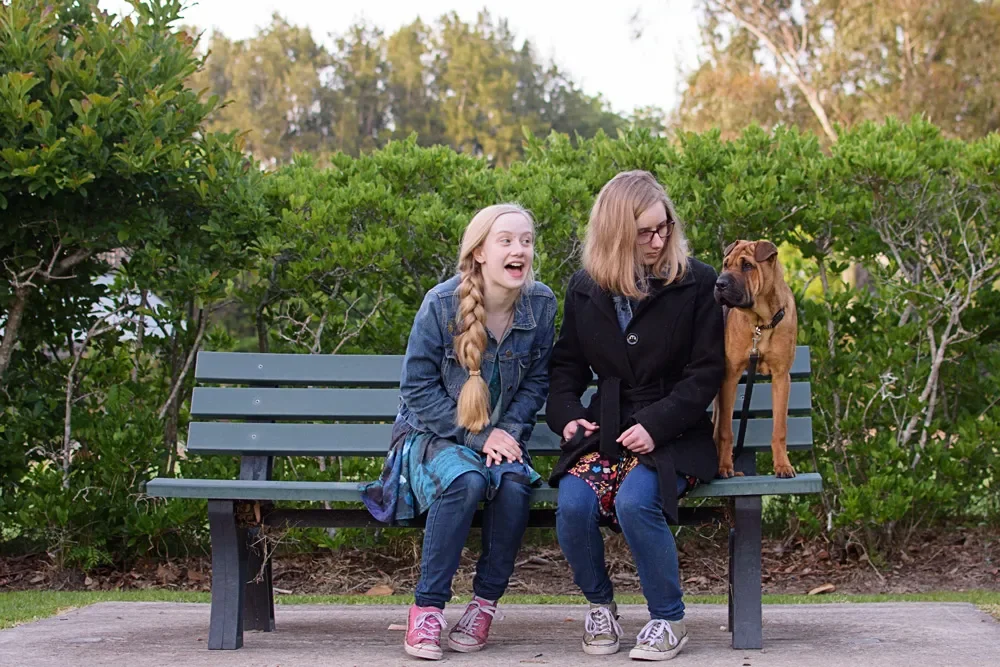
Gemma-Rose, Charlotte and Quinn are sitting on a park bench waiting for Imogen and Sophie to finish recording a music video. I wonder what my girls would have been doing on this weekday morning if we hadn’t found our way back to unschooling.
I wonder if you’ve always been unschoolers. Perhaps you explored other ideas before arriving at unschooling? Maybe you’re still exploring? I’d love to know whose educational ideas have influenced you the most!