How We Unschool Despite Strict Homeschool Regulations
Wouldn’t it be wonderful if we didn’t have to answer to anyone and could unschool our children with total freedom? I guess some people are fortunate to be able to do this. But we’re not. In our state of Australia, if we want to homeschool, we have to fulfil certain requirements.
Our children are supposed to follow the same syllabus as the one used in schools. And we have to prove they’ve done that. But how can we do that if we’re unschoolers? What if my girls aren’t at all interested in what they are ‘supposed’ to be learning? What if they want to do something else?
I can fight the system. Maybe the registration process will become more relaxed if we all protest and work together. Perhaps we won’t always have to live under this strict system. It’s possible we might gain the freedom to unschool without any restrictions. And I’m really hoping this will happen.
But what about now? How can we unschool TODAY without compromising our educational beliefs but still stay within the system? How does our family do that?
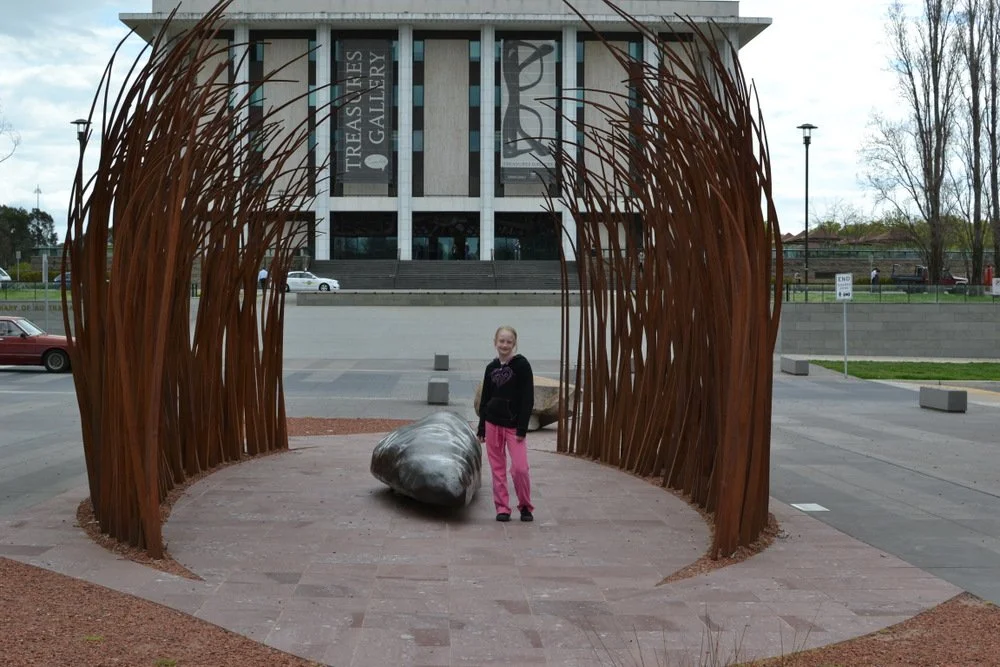
It’s fortunate my girls have a wide range of interests. (We are all visibly and audibly excited about anything and everything so I think that helps.) Usually, I can translate my children’s interests into the right educational language and apply it to all the required key learning areas without a lot of trouble. I just need to be good at matching up the right areas of the syllabus to what my girls are doing naturally.For example… We took a trip to Canberra not so long ago. When we came back, our heads were buzzing with all we’d seen at the various museums we’d visited. We’d heard about Walter Burleigh Griffin, the American architect who designed Canberra. He also bought acreage in Sydney, planning to build a community of knitlock houses which would blend in with the natural environment. Our imaginations were captured. We wanted to know more.
One thing led to another, and later when it came time to update my homeschool records, I realised the girls had shown interest in so many things that just happen to be ‘required’ learning, without any planning whatsoever. Their natural interest was enough to enable me to tick off a number of outcomes in the syllabus. Of course, Walter Burleigh Griffin might not be mentioned in the syllabus but ‘design’, ‘relationship with places’, ‘safe living’, ‘Federal government’ and other topics, which we explored, are.
So the girls learn, I record and life goes on.
But occasionally there are times when the girls show no interest in a required topic at all. What do I do? I could say to my girls, “You have to learn this and that and the other because that’s what the education department demands. When you’ve finished doing the required stuff, you can then go back to following your own interests.” But I don’t. Doing things only because you are required to isn’t real learning. It’s just a waste of time. My children wouldn’t really be unschooling if we worked in this way. I am not willing to compromise, even if compromising means we’d sail through the registration process without any trouble. Is there another solution to this problem? I think there is. I think we need to look at the school syllabus in a new way.
What is a syllabus? Is it a boring list of things someone not very important has decided our kids must learn? Or could it represent a whole range of wonderful learning experiences? EVERYTHING in this world is potentially interesting. This is a fascinating world we live in. Just because the educational department has marked some topics as essential doesn’t mean they automatically become boring and irrelevant. It is possible my children still might be interested in something that’s in the syllabus. How do I find out? I could do some strewing.Of course, I won’t look at the syllabus through schooly eyes. I’ll be looking past all the jargon that clutters up each requirement, that turns something potentially interesting into something deadly boring. I‘ll try to find something that ignites my own interest, something that makes me feel excited. Because if I’m not interested in what I am about to strew, there is less possibility my children will be interested.
For example, Sophie is supposed to know all about rates and ratios in maths. I took this from the stage statement for the maths syllabus for children her age:
Students are familiar with the concepts of ratios and rates, and apply these when solving problems.
I could say, “Sophie, you need to know about ratios. Let’s get this out of the way so I can tick it off. Just do this worksheet and we can say the topic is done.” Or I could try something else. This is what I did the other day:
I did a bit of browsing on the internet and found a video about scale models and then said, “Hey, girls, this is so interesting! (I was telling the truth, not trying to trick them.) Do you want to watch with me… “
The girls picked up on my tone of voice and came running. They were eager to share what I had discovered. Of course, I didn’t mention the word syllabus. Why should I have? Why spoil something genuinely interesting by associating it with the word ‘required’. This information isn’t the exclusive property of the education department. We are entitled to learn about it just because we want to. And many times that’s exactly what we end up doing.
So we watched the video and then we started talking about scale model cars, maps, model railways, model villages, dolls’ houses. Dolls’ houses? I remembered when Andy and I saw Queen Mary’s dolls’ house at Windsor Castle many years ago. Sophie and Gemma-Rose wanted to hear about it. They heard the excitement in my voice. I really did enjoy seeing that house. I found the fact that everything is a perfect scale model of something in real life very fascinating. And so did the girls. We found a website about the dolls’ house. Then we remembered our visit, a couple of years ago, to the model village, Cockington Green. The discussion continued. Ratios turned out to be a very interesting topic!

But what if my strewing fails? I could try again from another angle. And if that fails too I might just say, “I presented my children with the opportunity to learn such and such, but they rejected it.” Because all we really have to do is provide our kids with opportunities for learning. No one can force them to actually learn. They have to cooperate. And if they won’t, despite our best efforts, there’s not much we can do about it.Of course, there may be some things on the syllabus we feel are inappropriate for our children. I’d just gently object, saying they do not meet the needs of our girls, or go against our beliefs.
Looking for resources to strew, translating my daughters’ learning into the right kind of language, and trying to juggle their needs with those required by the educational authorities is hard work at times. I have to stay a step ahead of my girls, always on the look out for things that might interest them. I have to be aware of what’s in the syllabus and be creative about how I interpret the official requirements. I always have to ask the question, “What syllabus outcome matches what my girls have been learning today?”
Is all the effort worth it? We think so. My girls can happily follow their interests, unaware of all the behind-the-scenes work I’m doing that allows them to learn in the way that works best.
So we can unschool, despite the strict homeschooling requirement. We can still live an amazing unschooling life!
(If you do some browsing on the Internet it probably won’t take you very long to come across people who declare that unschooling is a lazy way of life. A lazy way of life? Oh my! They have absolutely no idea what they’re talking about!)
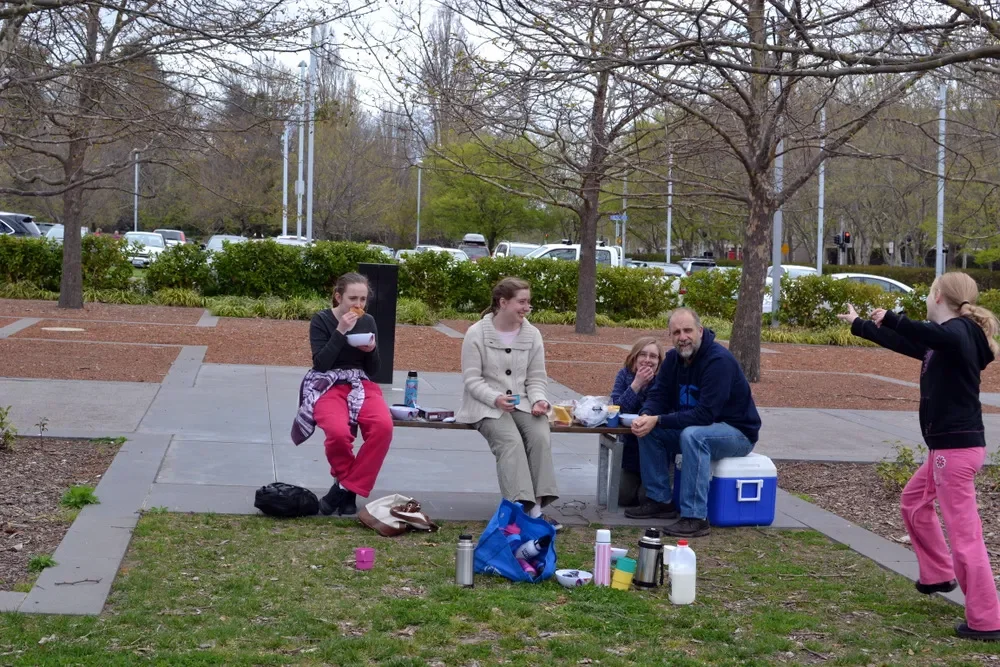
All the above photos were taken at Questacon in Canberra.