Is it Really Okay if Kids Play All Day?
Parents value play when children are very young. At this stage of life, we all agree that children should be playing. But what about when they get older? Should they still be allowed to play as much as they would like?
When children reach an age when they could go to school, play is often pushed to one side. It no longer holds the centre position in children’s lives. It’s now time for more serious things like learning about maths and how to read. Parents may no longer feel happy letting their children play all day. And perhaps, even if they are willing to let them continue playing, they are still a little worried. Perhaps they keep pushing certain thoughts to the backs of their minds: Are my children really doing anything of value? Are they learning? Should I direct them to more structured learning experiences? Perhaps children should do a few of the more ‘important’ things first and then play afterwards. Do some reading. Manipulate a few numbers. And then be allowed to go and play.
So what’s so special about play? Why is it valuable?
When kids play, they get an opportunity to let off steam. Play, especially the physical kind, relieves stress. It helps develop the imagination and creative thinking. While playing, kids try and make sense of the world by exploring different ideas and situations. Sometimes play can be a safe way to explore ideas that might be a bit scary.
Children discover interests and passions through their play. They try things out to see if they want to go further with them. One day, they might start to follow those interests and passions in a different way: Perhaps they’ll read books, explore websites, watch videos and make things associated with their play. Play may eventually develop into something that looks a lot like what most people would call ‘education’.
I think we’d be very surprised if we could see all the positive things that result from our children’s play.
I once spoke to my young adult daughter Imogen about play. She told me that play is a very important part of her life. Playing helped develop her imagination and creative thinking skills. (It still does.) Her writing, music, and all the other things she is passionate about have been influenced by the games she used to play when she was a child.
When my children were younger, they had lots and lots of free time for play. Most days, at morning tea time, all my girls would disappear out the back door with mugs of hot chocolate in their hands, chatting about the game they intended to play together. Hours later, distracted by hunger, someone would return to the house for food supplies. Then after munching sandwiches, they’d continue their game until dark.
Sometimes I used to wonder if I should be more involved in my children’s days. Was it really okay if I didn’t see them from one end of the day to the next? But looking back, I can see that having space to play away from any adult influence was just what my children needed. Kids don’t need us hanging over them, making suggestions, judging their games, or trying to direct them in a certain way.
My children often talk about the games they used to play.
Imogen says, “Do you remember that baby bath we had, Mum? Do you remember how we all used to climb inside? We used to try and push it over the ground using sticks. It was our boat.” Yes, we had a baby bath, but we never used it for the purpose it was designed for. The bath was a prop for imaginative play. Some days it was a pirate ship. Other days it was something completely different. (In case you’re wondering, I used to bath the baby in the laundry sink!)
“Do you remember the big tricycle we had, the one with the seat at the back?” asks Imogen. She once told this story as a blog post:
We used to live in a house with a steep hill on one side of it. The hill swooped down, down, down, before curving around the back of the house, and around a tree. It was a perfect hill for a billy-cart.
Not that we had a billy-cart. But what we did have was a tricycle. It was yellow and green and had two seats. And it was the perfect vehicle for flying down the hill on. Two girls would sit on the seats, the smallest girls, of course, because the seats were the safest position. And we two older girls hung one on each side.
Up to the top of that very steep hill, we pushed that tricycle. At the very top, we’d stop and arrange ourselves. Then, ‘One. Two. Three!’ We pushed ourselves off the top of the hill and went flying down the side.
Faster and faster the tricycle went. Faster and faster, and all the time we shrieked and shouted with glee. And faster and faster the tree at the bottom of the hill came closer. Would we make it this time? Would we get around the curve without spilling over or hitting the tree? Most often not. But sometimes, just sometimes, we’d go swooping around that corner and sail on down the garden.
Finally, we’d coast to a stop, unclench white-knuckled fingers, and push the tricycle back up to the top. Over and over again we flew down that hill. Until at last, one day, four girls were just too many, and the front half of the tricycle parted ways with the back half, ending our fun on the hill.
I suppose the tricycle game was a bit risky. The bike wasn’t designed for four children. The girls used to fall off. A serious accident could have happened. But even though I knew I might have to deal with scratches and cuts and bruises and broken bones, I still let my kids play their rather wild game. We have to let our kids be daring and risk a few spills and thrills. They have to test their boundaries. Learn what their bodies are capable of and how to control them. Be adventurous. If children don’t do all this, they could grow into the kind of people who will always choose the safe path, too afraid to do anything. Or they might go in the opposite direction and deliberately head out into extreme danger, to fulfil the need that was denied them as children.
Play has had a tremendous effect on my children’s lives. It has taught them a lot. It has helped turn them into creative and imaginative people. But even if play hadn’t influenced their learning in these positive ways, I would still have done things the same way. I’m glad I let my kids play for hours and hours just because of the joy it gave them.
Whenever my children share stories of their play, their eyes light up. Joy flows from them as they remember. The older ones tell me that they had a fantastic childhood. (The younger two are still experiencing happy childhood days!) And isn’t that what we want to give our children? We want them to grow up and then look back and say, “I really enjoyed being a child. My childhood was wonderful!”
I could have turned my children away from play, thinking that there were more important things for them to be doing. Serious things like academic studies, additional classes, and structured camps during holiday breaks. I could have filled up my children’s time with what most people call important activities. I might have put lots of pressure on them, hoping that one day all that activity would lead to an excellent education and eventually a good career.
But I could never have deprived my kids of their free play time. Why not? Because before children become adults, they have to be children. They have a right to enjoy their childhoods and should be allowed to play. That’s what children are designed for. That’s how they learn. That’s what they need to do.
Is it really okay if children play all day? I know some people might disagree if I voice my opinion, but I’m going to say it anyway: Yes!
This post is based on thoughts shared in podcast episode 74: Is Play Important for Both Adults and Children?
Photo
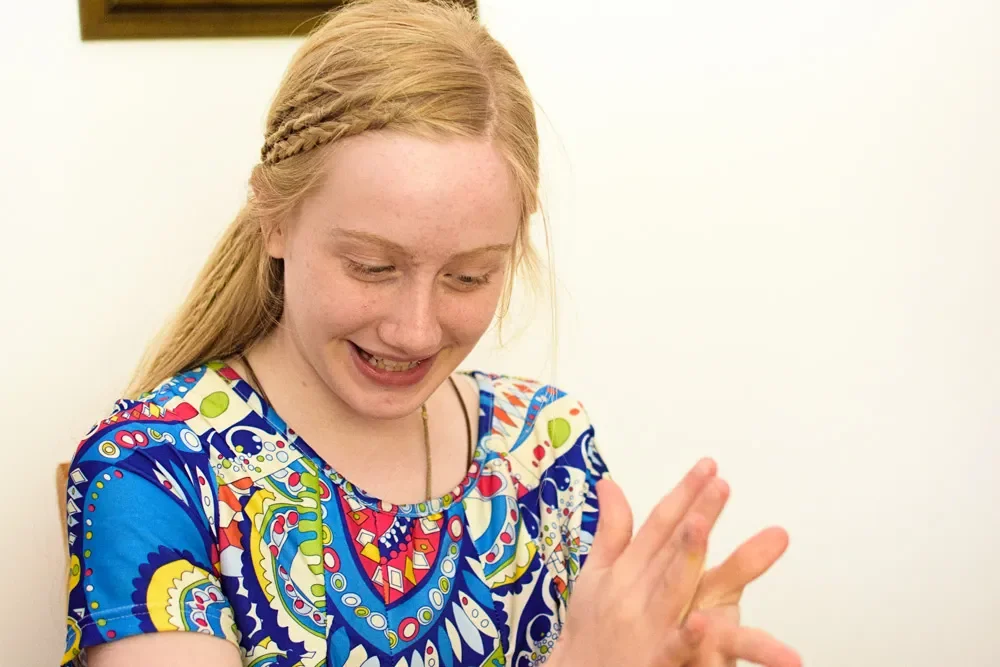
I no longer have young children who love to hurtle down hillsides on the back of tricycles. (Well, maybe my girls would still love to do that, but we no longer have a tricycle!) But they still love to play. Play is still an essential part of their lives. In this photo, Gemma-Rose is playing with salt dough. Her older sisters are also sitting around the table playing too!
The Crystal Tree
My daughter Imogen says that her childhood games helped develop her creative thinking skills and her imagination. All those long days of free play led to the publication of her first novel, The Crystal Tree. If you haven’t already done so, why not check it out? It’s available on Amazon as a paperback or Kindle ebook.
And if you’re interested in writing, Imogen blogs at Write, Rewrite, Read.
I wonder what games your children love to play. Do you smile when you think about your own childhood playing days? I hope so!