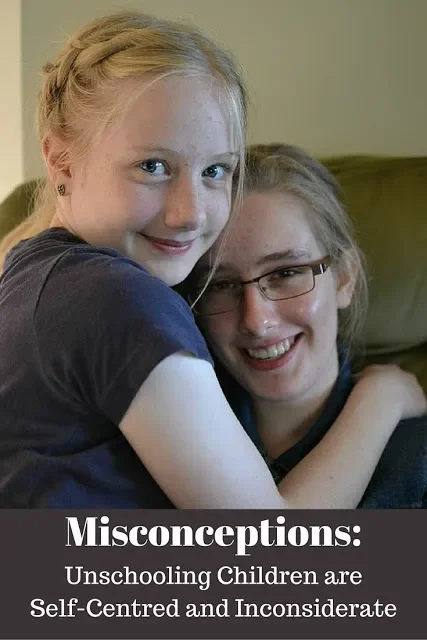
Imagine giving children the freedom to choose. What if they are allowed to follow their own interests, and do whatever they like? What if there are no rules?
Perhaps this sounds like a recipe for disaster. Will it produce self-centred and inconsiderate children? A lot of people believe it will. And maybe they’re right. We’ve all heard of children who run wild as soon as they realise they no longer have to answer to anyone.
If we say to our children, “You can do whatever you like,” and then stand back and let them get on with it, perhaps they will indeed become self-absorbed. But such hands-off parenting isn’t unschooling. Letting go of control is not enough. We have to do more if we want our children to use their freedom in the right way.
How do children know what is the right thing to do? What motivates them to use their freedom in a positive way? How do we encourage children to be considerate, and self-giving?
We could start with a parent’s example. If we want considerate children we need to be considerate ourselves. If we want them to be more interested in the needs of others than in their own, we have to be willing to give of ourselves even when it’s inconvenient and we are tired and it hurts. Being a good example is essential. We can’t just talk to our children about the virtues we want to instil in them. It’s not even enough to show them virtue by sharing stories of people we want them to emulate. We have to endeavour to be the kind of people we want our children to become. And that’s hard.
But encouraging our children to be self-giving involves more than being a good example. That can’t be enough because, of course, I’m not perfect. None of us is. So in addition to living a life where we are willing to make sacrifices for others, we also need to love our children unconditionally.
I try to be a good example, but sometimes I fail. My children see me fall, but they also see me pick myself up and try again. That’s important. They understand how tough it is sometimes to do what is right, and they forgive me when I go astray. Why? Because they know I love them unconditionally and I forgive them when they make their own mistakes. They are treating me how I treat them.
Mistakes? Yes, unschooled children won’t always make good choices. But as I said, this is true for everyone. We all have times when we fail to live up to our ideals. But I do think unschooling gives children an internal sense of right and wrong. It comes from being loved unconditionally.
Love can be used as a carrot. Parents might show their love when children behave well and withdraw it when they are displeased, in the hope their children will think twice about their actions and resolve to do better in the future. But does this work? I have found the opposite to be true.
When we know we are loved, even when we make mistakes, we will strive to do better. We want to be worthy of such unconditional love. Maybe some people doubt the truth of my words. Won’t children take advantage of such love? Surely they will think they’ll be able to get away with anything if a parent continues to love regardless of behaviour? This sounds reasonable, doesn’t it? But it’s not what I’ve experienced.
Love is so very powerful. I have been humbled by the love my children show me when I fail as a mother. I don’t say, “They’ll love me whatever I do so it doesn’t matter how I behave.” No, that love always encourages me to try harder, to be the best mother I can, to be worthy of the love I know I do not deserve but receive anyway. Love can change mothers. Why should it be any different for children?
Going hand-in-hand with good example and unconditional love is guidance. Unschooling parents might not make rules, but they do live by principles and values which they share with their children. As a family, we are always talking. We discuss anything and everything in a respectful manner which means we don’t lecture our children or talk at them even though we have more experience than them. Children are as valuable as parents and should be treated with respect. When I listen carefully and respect a child, she in turn will respect and listen to me. And then I can share my experience if I feel it will help. Of course, there are times when our children surprise us with their own thoughts. Sometimes they can teach us. Parents aren’t always right. This talking and listening and respecting each other results in us being connected to our children.
We can choose to give our children their freedom. Or we can hold onto them tightly. But why choose control when we know we can’t make children considerate and self-giving by force? Maybe you disagree with my last sentence, thinking we can indeed force children to behave as we think right. This is how I see it: The problem with control is that the motivation to behave a certain way is coming from outside the child. It comes from the parent who might not always be around to enforce it. To be truly valuable, the motivation to do right must come from within a child. We need to give her the opportunity to choose if she is to develop this kind of self-control. When a child is free to choose, she is free to give herself to others.
These are some of my thoughts on this topic, but they, of course, need to be backed up by evidence. What are real unschooled children like? I could tell you many, many stories about my own children to illustrate the points in this post. You’ll find lots of them here on this blog. Instead of repeating them perhaps I’ll just add a few links:
Getting Kids to Help with the Chores
Rules, Responsible Parenting and Radical Unschooling
Being Honest: Talking about Mistakes and Perfection
My children are considerate, loving, helpful, self-giving (but not perfect). They aren’t unusual. They are typical unschoolers. I think it is safe to say…
Just because an unschooling child has freedom of choice, this doesn’t mean she will choose to be inconsiderate and self-centred. That’s definitely a misconception.
PS Of course not all people who describe themselves as unschoolers are necessarily unschooling. This is why we can all say, “I know an unschooling family where the children are wild and self-centred… ” Perhaps we need to look past labels, to the principles people are living their lives by when we are looking for the evidence that will dispel the various myths.