Why it's Not a Good Idea to Read Slowly and Carefully
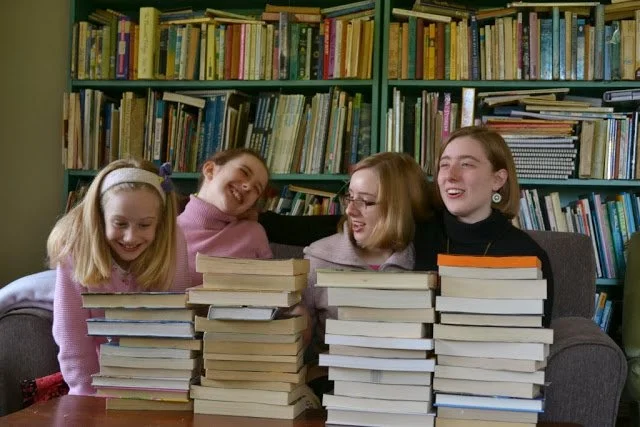
My girls come home from the library with towering stacks of books. Even as they walk through the front door, they have their noses between the pages of the first book in their piles. A couple of hours later, a sigh of contentment can be heard as a book is closed. “I enjoyed that!” By the end of the week, I hear, “When are we going to the library again, Mum?”
“Surely you haven’t read all your books yet?” I ask.
“We’ve read most of them,” replies Imogen. “There were a couple of duds we didn’t bother with, but we’ve practically finished the rest.”
“Slow down,” I urge. “Read them more slowly. Surely you don’t read them properly when you read so fast?”
The girls look at me blankly. Read properly? Of course they read properly.
I remember my eldest daughter devouring books at a similar rate. She was constantly turning pages. “Slow down,” I urged her. “Read all the words.”
“But I do!”
I shook my head in disbelief.
Even Gemma-Rose reads too quickly. At least in my opinion. Not in hers, of course.
Read slowly and carefully so you take everything in…
I’m sure we’ve all heard this advice. It sounds like common sense, doesn’t it? Well, I recently discovered it doesn’t make any sense at all.
A couple of weeks ago, I was browsing the library shelves and came across a book called Speed Reading by Tony Buzan. Initially I rejected the book: Just a gimmick, I told myself. But then I got curious and thought it wouldn’t hurt to pop it in my library basket. I could take it home and read a page or two, see what the book was all about.
It turned out to be a very interesting book. Apparently, reading slowly is inefficient. Retracing our steps to re-read sentences reduces our comprehension even further. Our brain is much more capable than we give it credit for. It can easily cope when we read quickly. It takes note of all the words even if we don’t have time to sound them in our heads. It understands everything. The brain can remember more when we stop wallowing in the words, and push ahead with speed.
There were a few reading speed tests in the book and my scores were terrible. I don’t read fast at all. I used to.
When I was at university I managed to read all my course work and fit in novel reading too. I can remember reading the whole of Gone with the Wind in a few sessions, in between studying for my final exams. And yes, I understood it all, and enjoyed it immensely, regardless of the fact I was turning pages at an incredible rate. I understood and remembered my course work too! I passed my exams.
Tony Buzan says university students read with the fastest speed, especially postgraduate students. They have to. They wouldn’t get through the great volume of required reading if they slowed down. They don’t read slowly and carefully. Instead, they read fast and efficiently.
Like me, most adults read slowly. After they finish studying, they let themselves slip back to a reading level of school students, even primary school students. I can believe this. All my girls read more quickly and more effectively than I do. I am rather alarmed by this. It’s not like I was unaware of it. The girls often have to wait for me to finish a book so we can watch the movie or mini-series adaptation: “How are you getting on with that book, Mum? Have you finished it yet?”
I just kept making excuses for myself: “I haven’t had time to read.” But I’ve had more than enough time. I should have been able to read a dozen books while plodding through just one.
So how do we speed up our reading?
We can use a guide like a finger or a pen to run along under the words. (A knitting needle is even better!) Maybe you thought that was a no-no. I did. “Take your finger away! You should be able to read without touching the page.”
We should see groups of words instead of single words…
Maybe I should just point you in the direction of Tony Buzan’s book. He says everything a million times better than me.
Speed reading seems to be something our children should be doing, and it’s also something parents can practice too.
Just think if I could read faster. My long list of unfinished books would soon shrink. My head would fill with all kinds of interesting things. My memory would improve. I could keep up with my children. Think of all the extra things we could share. I could surprise my daughters by finishing a book before them: “Have you finished that book yet, girls? Hurry up! I’m ready to watch the mini-series.”
If I could read faster, I could even enter a speed reading competition and become a champion! Now that would surprise my girls. It would surprise me too.
“Can we go to the library please, Mum?”
“You’ve finished all your books? That’s great. I bet you enjoyed them immensely.”
Did you notice? Not a word about slowing down and reading more carefully!